Troubleshooting armdrags and a special guest spot on Artechoke in a Can

Artechoke in a Can is a weekly video series by Marshal D. Carper taken from his no-gi classes at Steel City Martial Arts. The “artechoke” bit comes from the name of his publishing start-up, Artèchoke Media. Marshal had me up in Pittsburgh, PA last weekend to give two seminars–one at his Cal U grappling club and another at Steel City Martial Arts–and to shoot footage for an upcoming instructional. You’ll be hearing more about that over the coming weeks, but for now, armdrags! Here’s the technique where I share secret Rickson Gracie knowledge:

Link to video on Youtube.

The rest of the videos are up on Artechoke in a Can.

Crucifix Seminar Handout

With my crucifix and reverse omoplata seminar just over a week away (Sun, May 5 at Steel City Martial Arts in Pittsburgh), I wanted to share a handout that we’ll be giving to participants. If we can get our act together in time, we’ll also be giving attendees notepads and pens for note taking.

The seminar is being put on by Artéchoke Media, a Jiu-Jitsu publishing start-up founded by Marshal D. Carper. Marshal and I are also working on an instructional together, but we’re staying mum on the details until they we’re closer to release. Hint: you can safely guess the topic is related to the seminar.

This handout doesn’t cover everything that I’ll be teaching, but it hits the basics that I will definitely cover. It’s as many key points as I could fit on one sheet of paper.

Crucifix Seminar Handout

The crucifix fits into a bigger game of attacking the back. You’ll discover it fills certain gaps and solves problems. Even if you don’t add the crucifix game, I hope to give you a fresh perspective on positioning and control, and make you think about the difference between “the fundamentals” and “the fundamentals of an advanced position.”

Crucifix Basics

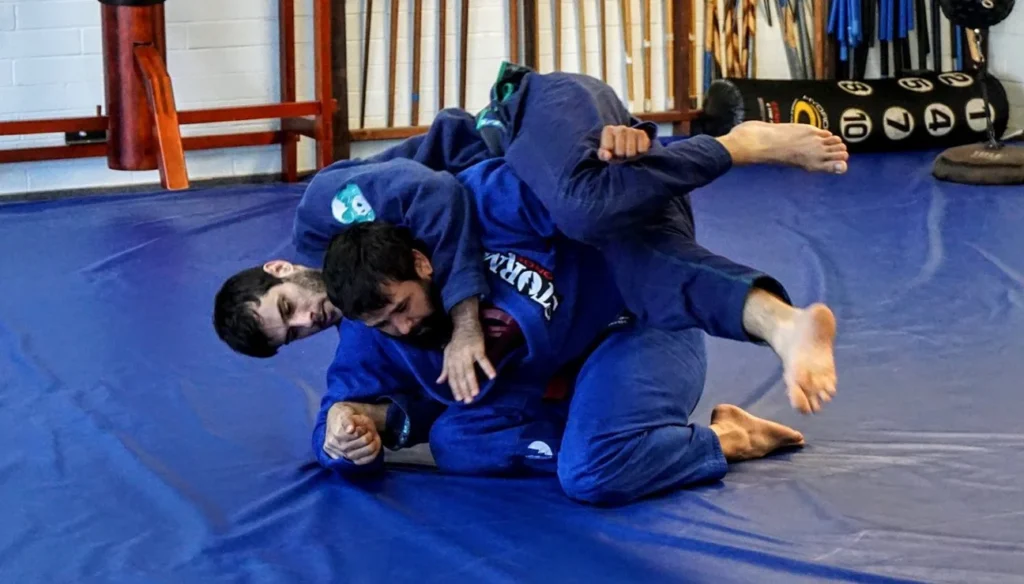
We will start with a basic crucifix so you know what our goal is during each entry. The most common and obvious crucifix entry: countering a bad (head outside) single leg. The usual mistake is trying to throw a hook in to take the back, only to be dragged down. Taking the crucifix is the simpler thing to do.

Crucifix on the knees – Maintaining position

• Harness (seatbelt) grip, or one-on-one with free hand posted far in front
• Hips heavy on their shoulder, lean to their rear, pressure on the arm
• Knees pinched, ankles crossed or triangled on their “hip side”
• Use the pressure of your hips and legs to break their grip if they join their hands

Sideride Basics – Maintaining position and getting the crucifix

• Grips: Harness, double lapels, or spiral ride
• Drive knee in behind elbow and shoot it forward to expose arm
• Step or stomp foot over arm and drag heel back to trap arm
• Sometimes they will just grab your leg if you put it in front of them

Rolling to the traditional crucifix (laying face-up)

• Keep your “head side” leg bent to trap their arm as you roll
• Roll over your “hip side” shoulder (the other way is awkward and dangerous)

Traditional crucifix – Maintaining position

• Keep a very tight harness, or grab behind your head, or control their wrist
• Don’t let them join their hands and turn toward your legs
• Bridge so they don’t slide down to escape or push themselves too high

Reverse Omoplata

This submission is awesome and simpler than you think. Here it is in 5 easy steps:

1) Trap the arm. 2) Cross the arm. 3) Reach inside. 4) Roll. 5) Finish.

Armdrag to crucifix

Link to video on YouTube.

After being a member of Jason Scully’s Grapplers Guide since its launch, I’m now taking on the role of regular contributor with videos like the one above. Here’s the write up I did for GG:

My instructor Eduardo de Lima showed me this idea a long time ago, and I’ve worked on it ever since. The leg position (hooking outside the knee) is something I came up with on my own, but I later refined it with help from Jeff Rockwell’s study of Baret Yoshida. That’s what the “super bonus” version is at the end, just showing how you can do the leg entanglement like Baret if you want (Jeff can speak on this better than I can [he's also a GG contributor]).

Doing the armdrag like this on purpose doesn’t happen much, since I’d rather have a clear path to the back, but anyone who has experience with the armdrag will think of times when they get stuck in the awkward situation of trying to climb to the back while the arm is under the leg. It often happens when they are trying to drive into you and get an underhook as you armdrag, or when they just grab on to whatever they can to stop you from going behind them.

If you want more crucifix goodness, and you’re in the Pittsburgh area, come to my seminar on May 5 at Steel City Martial Arts. The seminar is being put on by Artéchoke Media, a Jiu-Jitsu publishing start-up run by Marshal D. Carper. You’ll be hearing more about my work with Artéchoke soon!

Crucifix seminar in Pittsburgh on May 5 (only $30!)

Who’s in Pittsburgh? Come train with me! I’ll be at Steel City Martial Arts on May 5 to give a seminar on the crucifix. You can RSVP on Facebook or by contacting Marshal Carper at mcarper@gmail.com:

Here’s the full seminar info:

Matt Kirtley, the founder of Aesopian.com, is giving a seminar on his favorite position, the crucifix. This seminar will introduce the crucifix position, explore entries, counters, recounters, transitions, and finishes (including the reverse omoplata). All skill-levels welcome.

Matt is a black belt under Eduardo de Lima and an accomplished jiu-jitsu writer. He will be available for privates and group privates following the seminar.

Details:

May 5, 11am-2:00pm at Steel City Martial Arts
3842 Library Road, Pittsburgh, PA 15234 (Directions)

  • $30 for full seminar
  • $100/hour for private
  • $60/hour per person for a group private

Please contact Marshal Carper to register. Spaces are limited.

Presented by Artechoke Media, promoting the organic growth of jiu-jitsu thought, theory, and technique. ArtechokeMedia.com

Creating a personal development plan

Q: How involved do most instructors get in providing feedback and helping to map out development plans for their students? I mean, in providing constructive feedback like “I think you should work on [insert position/guard/movement] for the next two months.” I understand that I need to take a certain amount of ownership over my training, but am just looking for some guidance.

I got to a large school that has many class time options and pretty much a different instructor for each class, so I’m not sure that I have a single instructor that really “knows my game” well enough that they feel comfortable in trying to shape my development plan. If I ask something like “what are some good breaks/passes for me to focus on” I’ll get a decent answer, but I’m looking at something more big picture.

I could probably get some ideas from competing, but I feel like I have to work on pretty much everything. Any tips for how to get some better constructive feedback in order to focus my training? I’m fine with paying for privates (either with my instructor or another) but from reading forums it seems like most players recommend that privates be used once you already know what it is that you want to improve.

A: The depth of guidance you’re seeking is hard for a coach to give without spending a lot of one-on-one time with you. That attention is usually reserved for their promising competitors or private lesson clients, unless you have an overeager instructors with a lot of free time.

If you have an instructor you trust, you could try telling them what you told me. They’re more likely to have insights into your game than I am, and even if they don’t, it doesn’t hurt to ask. You may have even better luck finding a purple or brown belt to act as your mentor. They may not have the most prestigious rank, but they often make up for it by having the time to give you attention, especially if you can be a consistent and dedicated training partner.

Being told “only work on this” is something I usually see in the later belts (mid purple and brown) because the lower belts are about building broader skills. Specialization comes after you have a foundation to fall back on.

Like you said, competing will sharpen your focus and highlight what you need to work on. Don’t get overwhelmed by feeling you need to work on everything. Make a list to prioritize if you need to. Pick out a the main techniques, positions and strategies you want to work on. Put in the extra drilling, study instructionals and tournament footage, try to use it in sparring, and ask for feedback from training partners and instructors.

The frustration you feel is common, so don’t be discouraged. Even with private lessons and personalized coaching, you will always need to evaluate your own game. Don’t be afraid of asking others for help, but know that most of the answers you are looking for come from personal experience and trial and error.

How long it takes to get a black belt

Everyone is always asking how long it takes to get a BJJ black belt (and by everyone I mean white belts), so I’m going to tell you:

It takes exactly 10 years to get a BJJ black belt (give or take 3-6 years).

Here’s how I know this. Back when I did the last big BJJ gi survey, I also collected data about training habits and belt promotion timelines. We crunched the numbers and that’s what they revealed. The results are summed up by this graph. Taste the SCIENCE!

From White to Black Belt

This timeline confirms the conventional wisdom that it takes about a decade to get a black belt, though some do it faster and others take longer.

What speeds up promotions? The data tells us that too, and it’s not surprising. People who go to more classes and train the most hours get their next belt more quickly.

In other news, water is wet.

What this timeline of averages and percentiles doesn’t show are the stories of the individual people on their path to black belt. They don’t reflect the daily struggles, the medals and the losses, the injuries and recoveries. These stories can’t be easily simplified to a line on a graph, but that won’t stop me from trying!

Let’s take a look at two black belts. First is Bill Hotter.

Bill-Hotter

Who is Bill Hotter, you ask? He is a long time Sherdog Grappling member, a black belt under Cesar Gracie, and an all-around cool guy. The dotted line represents a 5 year hiatus he took from training. You can get a good sense of his attitude by reading about his BJJ road trip (part 1 / part 2) and his opinion on how often to train.

Jumping to the other end of the spectrum, here’s everyone’s favorite rooster weight, Caio Terra!

Caio-Terra

Caio gave me this estimated timeline for his promotions. His secret? Candy. Nothing but candy. (He’s willing to submit to testing for that.)

As fun as it is to try to measure yourself against these timelines, remember that the speed of promotion doesn’t really matter, so don’t be sad if you’re “behind schedule.” Knowledge, skill and personal development come first, and the belts are a nice recognition for your hard work.

More graphs like these are coming soon, from world champions to blue collar black belts. I’ll also be getting more of their personal stories and their advice for people still working their way up. If you want yourself or your instructor profiled here, give me a holler. You’ll get to plug your school and your sponsors if you do!